Geographical Database for photos, videos, GPS Coordinates, news, and project descriptions. » German Reef Ball Projects and Photos » Balticsea » Holtenau
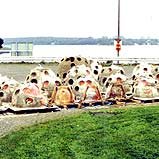
The private company MariLim created the first artificial reef in the Baltic Sea, consisting of Reef Balls on the 15th of June 2001. Reef Balls are half-round reef-modules having a central cavity with several openings. They were made out of marine friendly concrete with a pH-value similar to seawater. Hereby a rapid settlement of organisms is possible.
The balls were deployed in an area off the Holtenau bathing facility (Kiel).
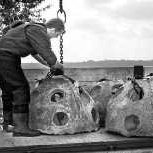
Four groups of Reef Balls were manufactured, which differ in concrete mixture and surface texture to determine the most suitable mixture. All in all 12 Reef Balls were deployed. In a first step each of them was lifted into shallow water by crane. After that the structures were draged by boat to the desired area. Subsequently, the deployment was done randomly. A diver was present all the time coordinating the work.
It is the aim of this study to monitor the speed of settlement and to determine the diversity of the algal and animal community living on or associated to the balls. On the 4th of July 2001 the first samples of the surface community were taken by a diver. From each ball an area of 10 by 10 cm was sucked off using an underwater sucktion device. The remaining residue was conserved for subsequent laboratory analysis. Additionally, samples for the determination of the benthic microorganisms were taken. This kind of sampling will be continued on a two weeks basis to get infromation about the succession of species. In order to incorporate larger species in this study scuba census is performed regularly on each ball.
Figure 1: Only days after the deployment the settlement started.
The four different groups of Reef Balls will be tested statistically for differences in quality and quantity.
Only a week after the deployment a check dive revealed that settlemet of the outer surface had already begun. A macrophytic green algae of the genus Enteromorpha sp. and a sessile polychaete worm (Polydora sp.) were found. The beach crab carcinus maenas was also very present in the inner cavities of the structures.
Figure 2: Strong occurance of Enteromorpha sp. two weeks after deployment.
After three weeks the surface was colonised by a variety of invertebrate animals. Juvenile Black mussles (Mytilus edulis) and barnackles (Balanus improvisus) occupies wide areas. The carnivorous starfish Asterias rubens live in densities exceeding 100 individuals per ball.
The reef was also accepted by various fish species. The recorded species contain several species of the genus gobiidae. Frequently, individuals were observed feedind on the reef strucutres. Also ?Sea skorpions? (Myoxocephalus scorpius) were found frequently in the central cavity of the balls. Beeing acitve mainly during the night, this species might use the reef as a resting area during the day.
Figure 3: Occupation of the whole surface area by a diverse algal and animal community four weeks after deployment.
The inner cavity of the balls is also occupied by sea squirds (Ciona intestinalis). These filter feeders may find suitable current conditions here.
In the near future a further increase of species number and diversity is very likely. The settlement of long living (perannual) algae also seems to be just a question of time.
East Sea, Kieler Förde PADI Aware Reef Ball Project
| Total images: 6
Despite the approaching winter season the next project was initiated in Germany by Joachim Warner from the Diver?s association ?Fördetaucher?. His cooperation partner was the DC ?Baltic Dive Center?, located just a few 100 meters away from the selected immersion site
The site was an almost lifeless and sandy plain in the so-called Kieler Aussenförde. It was a location of an approximately 13 - 14 meters depth that could easily be reached from ashore. A local company provided for the cement and the German Navy supported them with the heavier technical equipment. The latter also supported them at the immersion day with the shipment of the moulds from the production area to the actual immersion site.
Ten days after the official immersion on November 11 the first animals were observed. Ever since a relentless settlement has taken place, observed closely by ?Fördetaucher? and the University of Kiel. In order to protect the fragile site, the exact location of the balls will not be published before the resettlement has been accomplished successfully.
All images are copyrighted 1993-2007 (C) by Reef Ball Foundation, Inc. and by the original photographers. High resolution versions of most newer images are available by emailing your request
to reefball@reefball.com. (please provide the URL of the photo requested) Use of images requires a link to www.reefball.org crediting Reef Ball Foundation as the photo source. Please email any photos
you have with Reef Ball images to us and we will post in this photo database. Please indicate if you are freely sharing the photos or wish to retain your original copyrights and we will note that when posted.