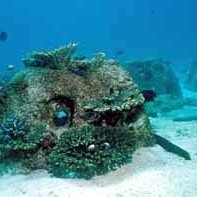
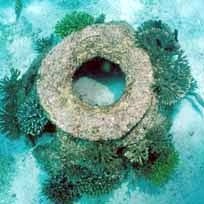
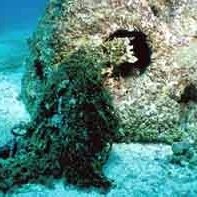
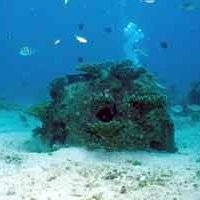
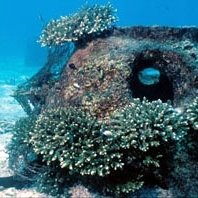
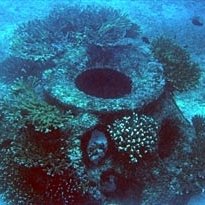
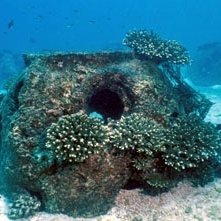
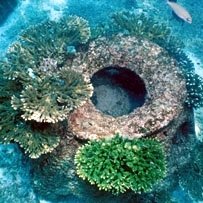
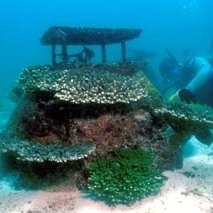
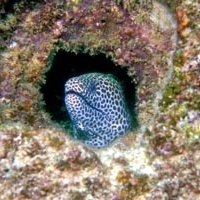
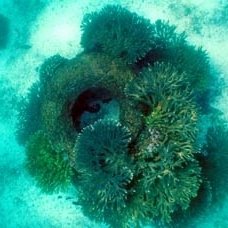
Monitoring revealed rapid horizontal growth (up to 2.5 cm/month) in a colony of Acropora downingi on a Shallow Reef Ball.
INITIATIVES TO PROMOTE CORAL-REEF GROWTH YIELD BETTER-THAN-EXPECTED RESULTS
Human activities, such as sea fishing, marine recreation and coastal construction, appear to be damaging coral reefs throughout the world - Oman included. But at least in the Sultanate the Ministry of Regional Municipalities and the Environment (MRME) has joined forces with Sultan Qaboos University (SQU) to do something about it. In a project sponsored by Petroleum Development Oman (PDO), the MRME and SQU are investigating whether artificial reefs can be built by means of reef balls: large, perforated, spherical shells of chemically adjusted concrete that provide a ready-made habitat for fish and a substrate amenable to marine growth. Preliminary results now give reason for the project members to be optimistic.
With the help of the Ras Al Hamra Sub Aqua Club, 40 reef balls were lowered into place in 1999 around the Fahal Island and at other locations in Muscat's Ras Al Hamra bay. The reef balls were originally intended to stimulate the growth of "soft" coral. But recent examination of the sites by SQU researchers have shown that "hard" coral has begun growing on the structures as well.
"We have had some great results with the soft coral," said PDO's Health Safety and Environment Manager, Mr. Frans Willekes . "The fact that hard coral has started growing on the reef balls by chance shows that this type of coral can be transplanted here. We now want to monitor this juvenile coral and explore the possibility of transplanting other species."
The speed with which the reef balls have been colonised by coral also came as pleasant surprise to the researchers. "It was thought by many that it would take years for coral to establish itself, but the results with the soft corals show that nature can do much better than that," said Mr. Willekes.
In a separate initiative, PDO is also helping to stop the erosion of existing, natural coral reefs by donating 17 mooring buoys that will be deployed at reefs along the Batinah coast and at Damaniyat islands. The buoys are being given to the Royal Navy of Oman who will place them near sites popular with divers. Dive boats will have to moor on these buoys rather than dropping anchor, thereby avoiding damage to the reefs.
(Coral reefs are limestone formations build up over thousands of years from the fused skeletons of small, sedentary invertebrate marine animals of the Coelenterate phylum. They are found - sometimes in massive accumulations - in shallow, tropical marine waters, where they serve as a habitat for marine ecosystems).