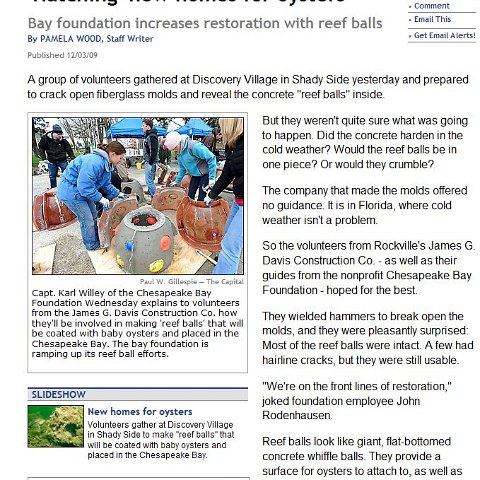
Anglers create reef balls for underwater habitat By PAMELA WOOD, Staff Writer They're dome-shaped, made of concrete and full of holes. And they'll make a great home for oysters, fish and other critters. In the searing heat yesterday, a crew of volunteers created the latest set of "reef balls" that they'll sink in the Chesapeake Bay later this summer. "You get an ecosystem developing on the reef, from microscopic organisms to flora and fauna," said Pete Abbott, vice president of the Annapolis chapter of the Maryland Saltwater Sportfishermen's Association. The group is spearheading the reef ball effort, designed to improve fishing and help the environment. For the past two weeks and through next week, MSSA volunteers are pouring and "hatching" the reef balls at Discovery Village, an environmental center in Shady Side. Creating the reef balls involves piecing together round molds and strategically placing inflatable balls inside to create the igloo-like shape and holes of various sizes for fish to swim in and out of. Once the molds are secure, concrete is poured from a truck via a long chute. Volunteers then follow behind and tap the molds to get rid of any air bubbles. After drying, the reef balls are "hatched" from the molds, looking something like giant concrete whiffle balls. It takes about a month of curing before the reef balls are plunked about 35 feet deep in the Chesapeake Bay. The launching point will be just off of Hackett Point on the Broadneck Peninsula. Once in the water, the reef balls should attract oysters that attach to the surface, and fish and crabs seeking shelter.
Fishing group pins hopes on reef balls By PAMELA WOOD, Staff Writer Bobbing in a powerboat in the middle of the Chesapeake Bay, Kevin McMenamin watched as the crew on the nearby Patricia Campbell started its work for the day. The men lowered the vessel's huge crane and fastened it to one of the concrete balls stacked on the deck on the custom-designed 60- foot oyster restoration boat. "They look pretty in the parking lot, but I'm definitely looking forward to having them in the water," Mr. McMenamin said of the oddly shaped structures covered with holes like wiffle balls. Soon enough, one of the Patricia Campbell crew members called out over the speakers, "Go ahead and set it down." A few moments later, the first of 70 "reef balls" was gently lowered to the bottom of the bay, where hopefully they'll attract marine life, including fish and oysters. The balls got their start about a month ago at Discovery Village, an educational center in Shady Side, where volunteers from the Maryland Saltwater Sportfishermen's Association poured the concrete into molds to create 140 structures. After curing, half of the reef balls were loaded onto the Patricia Campbell by a team from the Chesapeake Bay Foundation and the Maryland Environmental Service, an independent state agency. In ones and twos, the balls were placed a few feet apart yesterday on a spot called Dolly's Lump off of Hackett's Point, directly south of the Bay Bridge. Later this summer, the rest of the association's reef balls will be added to the site. Then the area will be monitored twice in the next year to see if the balls are working as planned.
Fishing group pins hopes on reef balls By PAMELA WOOD, Staff Writer Bobbing in a powerboat in the middle of the Chesapeake Bay, Kevin McMenamin watched as the crew on the nearby Patricia Campbell started its work for the day. The men lowered the vessel's huge crane and fastened it to one of the concrete balls stacked on the deck on the custom-designed 60- foot oyster restoration boat.....