Reef Ball Foundation Photos and Project Description Database


Only Search Reef Ball Photos and Project Database
Up one level Geographical Database for photos, videos, GPS Coordinates, news, and project descriptions. » Louisiana Reef Ball Projects and Photos

Louisiana Reef Ball Projects and Photos
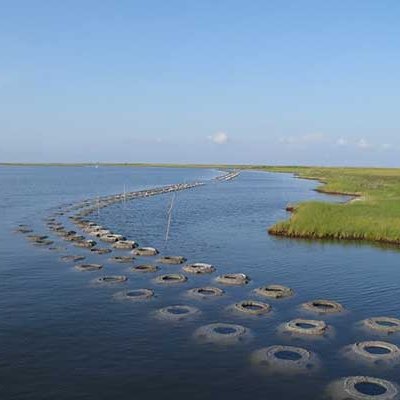
Louisiana artificial reefs are focused largely on inshore activities since the offshore is dominated by the outflow of the Mississippi river. Reef Ball efforts include reefs in Lake Ponchartrain and erosion control assistance for marsh stabilization. One LSU researcher has even proposed Reef Balls as a possible solution to reduce global warming by CO2 sequestration into the cement of Reef Balls and by the biological activity of Reef Balls. Click here for World Mapping System Information on Louisiana

aquariumoftheamericasreefballdisplay
Explore this folder
Aquarium of the Americas Reef Ball Project Photos  |  Total images: 1
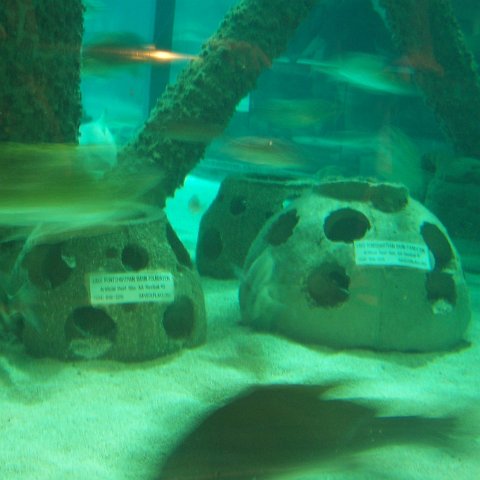
The Aquarium has added several Reef Ball sizes to many of the exhibits.
dema1996neworleans
Explore this folder
dema1996neworleans  |  Total images: 9
dema1999neworleans
Explore this folder
Diving Equipment and Marketing Association Trade Show  |  Total images: 3
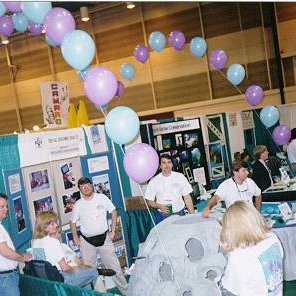
Reef Ball will had a booth at the Diving Equipment and Marketing Association Trade Show in New Orleans (booth 4436)
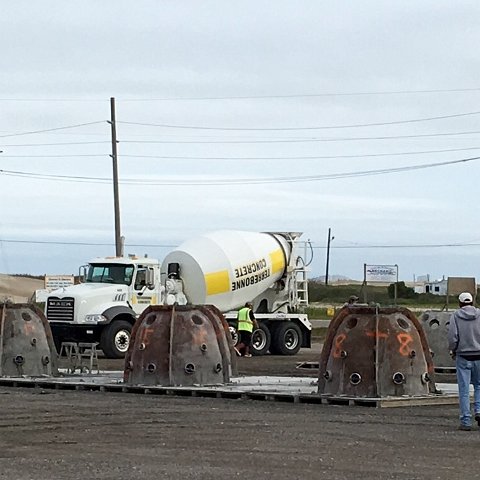
departmentofenergyco2sequestrationfeasibilityusingreefballs
Explore this folder
departmentofenergyco2sequestrationfeasibilityusingreefballs  |  Total images: 5
lakeponchartrainproject
Explore this folder
Lake Ponchartrain Reef Ball Project Photos  |  Total images: 16
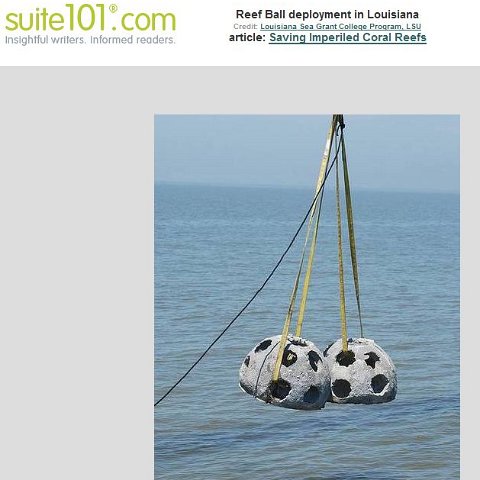
Over 600 Reef Balls were placed in Lake Pontchartrain and amazingly they survived hurricane Katrina intact. Coastal Reef Builders, Inc. supplied the Reef Balls from Pensacola, Florida. Five experimental artificial reefs on the bottom of Lake Pontchartrain are attracting more than just sea life. Anglers crowd the sites on weekends, said Michael Poirrier, a University of New Orleans biology professor who leads the data collection team monitoring how the empty concrete globes with holes are working. "They are the new fishing spots," said Kelly Whitmore, a UNO biology graduate student who is collecting data on the success of the reefs. The reef balls are concrete half-globes with volleyball-size holes that provide a haven for sea life. They've been preferred for making artificial reefs since the initial effort, at the Lakefront Airport, which is made of Arkansas quarry limestone rubble. Using reef balls instead of rocks produces more current breaks, which in turn attracts more small fish, experts say. Plankton, small fish and large crawfish ride the currents and go to the reefs, Poirrier said. Large fish feed on them, and fishermen feed on the large fish, he said. On weekdays when the wind is calm and the weekend fishermen are gone, Poirrier, Whitmore and several biologists and undergraduates go diving to identify and count the creatures that have taken refuge around the sites. Whitmore said that when the wind has been calm for several days, underwater visibility can be as good as 10 feet. She has seen speckled trout, flounder, catfish, sheepshead and jack crevalle, which "look like tuna but don't taste as good," she said. Whitmore said the reefs are interesting places to observe. "You never know what you will see: blue crabs poking out of the holes, eels," she said. "It's an adventure." The study will include how the reef balls respond in the lake's brackish, low-salinity water, Whitmore said. Reef balls are used in high-salinity waters in other parts of the world, she said. The census data will be used to determine whether more reef balls can be placed elsewhere in the lake, Whitmore said. Any visitors to the reefs are welcome to submit a report on their findings, which will be tabulated in the census, she said. A form that can be e-mailed to her is available at. The final report on the census is to be finished early next year, Whitmore said. The foundation is talking with the state Department of Wildlife and Fisheries about the project's second phase: creating a dive park in the lake, toward Slidell, said John Lopez, director of the Lake Pontchartrain Basin Foundation's Coastal Stability Program. Snorkelers could see sea life under the lake there. "People don't know what's under the lake," Lopez said. The reef would be a research station with the potential for biological monitoring, Lopez said. The reefs are part of an effort to re-establish a hard bottom to areas of the lake affected by past shell dredging, Poirrier said. The first reef was installed in July 2001 near the Lakefront Airport. Reef balls were placed in September and October 2003 at three former oil platform sites west of the Causeway in Jefferson Parish, and a fifth one was placed January 2004 south of Mandeville in St. Tammany Parish, Lopez said.
news
Explore this folder
news  |  Total images: 1
TerrebonneBayShoreProtectionDemonstrationProject
Explore this folder
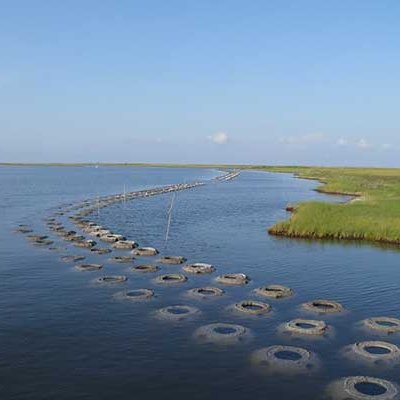
TerrebonneBayShoreProtectionDemonstrationProject  |  Total images: 1
usfishandwildlifeproject
Explore this folder
U.S. Fish and Wildlife Service Reef Ball Oyster Project  |  Total images: 0
Reef Ball was gracious enough to provide us with 5 or 6 mini-balls and 2 of the new oyster shell aggregate finished oyster balls so that we could conduct spat set tests here in coastal Louisiana. Those tests were to assess various material types for our soon-to-come (I hope) marsh/shore protection project. The tests have been completed and reefballs appear to be the winner (having the most oyster spat per unit surface area). Once we have the surface area computations completed, we should be able to send you a report. Dr. Earl Melancon, a professor at Nicholls State University (Louisiana), has conducted these tests and is having students develop the results. He is excited about the reefballs. After 2 months in the water, we had a BIG stone crab residing inside one of the oyster balls!


All images are copyrighted 1993-2007 (C) by Reef Ball Foundation, Inc. and by the original photographers. High resolution versions of most newer images are available by emailing your request to reefball@reefball.com. (please provide the URL of the photo requested) Use of images requires a link to www.reefball.org crediting Reef Ball Foundation as the photo source. Please email any photos you have with Reef Ball images to us and we will post in this photo database. Please indicate if you are freely sharing the photos or wish to retain your original copyrights and we will note that when posted.