Reef Ball Foundation Photos and Project Description Database


Only Search Reef Ball Photos and Project Database
Up one level Geographical Database for photos, videos, GPS Coordinates, news, and project descriptions. » Florida Reef Ball Projects and Photos » East Coast Counties on the Atlantic Ocean (Jacksonville to Key West Including Offshore Oculina Banks) » browardcounty » dania

dania


igfatouchtank
Explore this folder
International Game Fish Association Touch Tank  |  Total images: 1
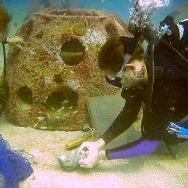
Scientists place the reef balls on the bottom of the ocean anywhere from 5 feet deep to maybe a 100 feet deep. Algae will grow on it and polyps from reproducing corals near by will land on the reef ball (the reef ball acts as a structure for life to begin instead of trying to beat the odds by landing on plain sand). Once a single polyp lands on the ball, it will reproduce until it becomes a community. What is super cool is that there is another organism called zooxanthellae. Huh? Zooxanthellae are microscopic dynoflagellate ? algae- that live symbiotically with the coral. Symbiotic means they live together and are advantageous to each other. The algae provide photosynthetic food for the coral and a protective cover from sunlight and temperatures; in turn the coral provides protection and a structure for the zooxanthellae to live. Now that the reef ball has algae and corals growing on it, to make it a habitat, there has to be more organisms living there. The holes in the structure make great hiding places for small fish, crabs, shrimp, etc. Many fish and crabs can eat algae that grow on it ? so it attracts even more animals. Once you look at the whole thing, you will see that a coral reef community has a high diversity of organisms ? comparable to a rain forest!
memphisgroundingproject
Explore this folder
NOVA Southeastern Reef Ball Research and Coral Restoration Project  |  Total images: 61
The United States Submarine Memphis (Figure 1) ran aground in approximately 10 meter depth on a coral reef off southeast Florida (Figure 2) February 25, 1993. Extensive physical damage to the reef substrate and injury to the coral community were attributed to the initial grounding and subsequent attempts to free the submarine from the impacted reef (Figures 3 and 4). The impact of the grounding was assessed, and the area of damage was determined through field and photographic studies. An impacted area of 2,310 m2 was assessed with 1,205 m2 having been totally destroyed (Figures 3 and 4). In 1997, the State of Florida was awarded a settlement of $750,000 by the Federal government for environmental damages caused by the submarine grounding. A plan to perform hypothesis testing of restoration techniques was developed and initiated. Using artificial reefs as experimental platforms, we are examining three restoration strategies: 1) the potential of enhancing coral recruitment through the use of coral larval attractants, 2) the effect of reef structure on the associated fish assemblages, and 3) the interaction between fish assemblages and coral recruitment and survival.
monitoring
Explore this folder
Dania Beach Monitoring  |  Total images: 4
Just off the coast of Dania Beach, Florida, in 40 feet of water lies a treasure of a different kind. A 6,000 year-old reef, as precious to underwater ecology as the finest jewels - once thought damaged beyond repair - now has a chance to be healed. A scientific project there could hold the promise of reef regeneration, to undo the damage of too many anchor gouges and boat scrapes over centuries of time. Using hollow, spherical, molded concrete "igloos" to promote marine growth, the program is being called - for lack of a more glamorous name -the Reef Ball Project. Our reefs, the "rainforests of the sea," provide vital resources and services to millions. Without them the joys of boating and our marine recreation industry - perhaps our entire planet - could be in jeopardy. But why is a 6,000-year-old reef off the coast of Dania Beach, Florida so important to the marine industry? The reasons are many and whether you are a recreational boater or you make your living on the water, the fate and well-being of this ancient reef could have profound effects on future boating, diving and fishing. Those of us who have leisurely floated over a reef, or spent time reef fishing, know the beauty and value of these natural resources. Found only in tropical and semi-tropical waters, coral reefs are some of the oldest, most diverse and productive ecosystems on earth. These "rainforests of the sea" provide livelihoods, recreation, tourism, food, protection from storms and erosion and more recently, medicines that hold the promise of cures for many diseases. In addition to benefiting the marine industry, healthy reef systems, we find more and more, are an essential part of our ecology, even for landlubbers who never venture near the water. One early morning in 1993 the USS Memphis, a 360-foot nuclear submarine, ran aground a few hundred yards off Dania Beach, while preparing to conduct tests with the U.S. Naval Surface Warfare Center at Port Everglades. In the process of attempting to free itself from the grounding, the sub's propeller cut a 75 foot-long trench through the coral reef, impacting an area of approximately 25,000 square feet and totally destroying a 1,200-square-meter area of marine habitat. In seconds, a treasure that took thousands of years to form was destroyed. The reef off Dania Beach has now become part of a scientific research project and restoration effort conducted by the National Coral Reef Institute (NCRI). Research on reef restoration is one of the main goals of NCRI. The Institute, established in 1998 by congressional mandate, is located at Nova Southeastern University's (NSU) Oceanographic Center at the entrance to Port Everglades. Florida sued the Navy for the loss of habitat and was awarded $750,000. A portion of those funds is now being used to study how to restore and repair the damage. A new underwater system, called Reef Balls - a commercial artificial reef design - is being used as a tool in the restoration process and analysis. Reef Balls are the invention of Todd Barber, a young man compelled to do everything he can to save the world's coral reefs. Barber's quest began when his favorite reef in the Cayman Islands was destroyed by a hurricane. He wanted to do something about it, something different. "Most artificial reefs are created by sinking ships or concrete rubble. This does nothing more than create an underwater junkyard," says Barber. In addition to wanting to create something very different, Barber wanted to create something very permanent and he feels he has succeeded, claiming that Reef Balls will last a minimum of 500 years. To date, half a million Reef Balls have been deployed in 3,200 projects in 50 countries. Barber says studies are proving them to be more economical, stable and marine friendly than surplus ships and other debris. Ranging in size from six inches to six feet and weighing from six pounds to 6,000 pounds, the 1,600- pound Reef Balls deployed at Dania Beach by NCRI are considered mid-sized. Under the supervision of employees of Reef Ball, Inc., graduate students from NSU's Oceanographic Center made the modules from a special patented mold, with concrete suitable for the marine environment. The surface texture of the balls allows tiny marine organisms to easily attach, while the varying hole sizes and cavities mimic nature, providing shelter for fish and marine invertebrates. The pods - 160 of them, resembling some strange offspring from outer space - were towed to the site by barge. Then a sea-going crane lowered them, sporting cavities and hidey-holes in their basic shells, to the bottom in 40 feet of water . Arriving at their final resting place, they are clumped in groups of four, as festive grey families in a surprisingly natural-looking colony. Forty quads cover an area approximately 700 yards by 300 yards wide. Ten quads have cinder blocks in the center, ten have plastic mesh in the center, ten have a mixture of block and mesh and ten are simply hollow in the center. Some have implanted areas of actual living corals, harvested from the local area to help propagate new coral growth. According to Richard Spieler, Ph.D., professor and principal investigator of the project, using different sized materials in the cavities of the Reef Balls will allow for differing refuge sizes that attract and shelter fish of many varieties, just as natural reefs do. Scientists are studying how the differing fish assemblages interact with the settlement, growth and mortality of coral. Graduate students Elizabeth Glynn and Pat Quinn monitor the reef every three months to report on the restoration process. Glynn reports that the transplanted plugs of star and maze coral from a nearby healthy reef are growing and attracting other coral. "This is hypothesis-testing to formulate a recipe to restore reefs," says Glynn. The way coral reefs propagate is well known to the scientific community, according to Quinn. Research indicates that corals are attracted to areas where other corals are living. Once a year, during full moon periods, corals - as do may other creatures and plants - produce fertilized spawn. In dense, colorful clouds, the larval spawn rises over the reefs. This "planula," as the larvae are called, drifts with the tides to other areas where they settle and form new colonies. Quinn has also done two fish counts and reports that his "children" are doing very well. "Fish have settled and grown," he says, "but we still haven't been able to answer one of the great mysteries of the artificial reef: are we increasing the fish population or just moving the population?" Spieler points out that all anyone has to do is type in 'coral reef' on the Internet and they can learn the disturbing facts and statistics - the world's coral reefs are in serious trouble. One dire prediction estimates that unless things change in the next two to four decades, both human and natural causes will destroy 70% of the world's reef systems. "There is hope on the horizon though" said Spieler. "This project will help us gain insight on how best to restore coral reefs and how to jumpstart the restoration process. Down the road, boaters, fisherman and divers will benefit from this investigation." A world without coral reefs would be very different. It would be a world without habitats for millions of species of marine animals and plants, which would no longer be with us. Popular fishing and diving destinations would no longer exist, meaning certain jobs would also be lost. Our coastlines would be left unprotected and certain research possibilities of new cures for cancer, arthritis, HIV and other diseases would be lost. The effects of a world without coral reefs would be far reaching. What makes restoring the reef damaged by the Memphis important is that it holds great hope and promise for other reefs. "Research and repair of damaged or downgraded reef systems is vitally important," says Richard Dodge, Ph.D., dean of the Oceanographic Center and executive director of NCRl. "We are making the link to help this happen in a productive way with a cutting-edge investigation." The problems facing coral reefs today are staggering, but understanding the importance of coral reefs is a major step in the ongoing effort to save them. We all have a stake in keeping our reef systems healthy. They are our treasures of the deep.
news
Explore this folder
news  |  Total images: 2


All images are copyrighted 1993-2007 (C) by Reef Ball Foundation, Inc. and by the original photographers. High resolution versions of most newer images are available by emailing your request to reefball@reefball.com. (please provide the URL of the photo requested) Use of images requires a link to www.reefball.org crediting Reef Ball Foundation as the photo source. Please email any photos you have with Reef Ball images to us and we will post in this photo database. Please indicate if you are freely sharing the photos or wish to retain your original copyrights and we will note that when posted.