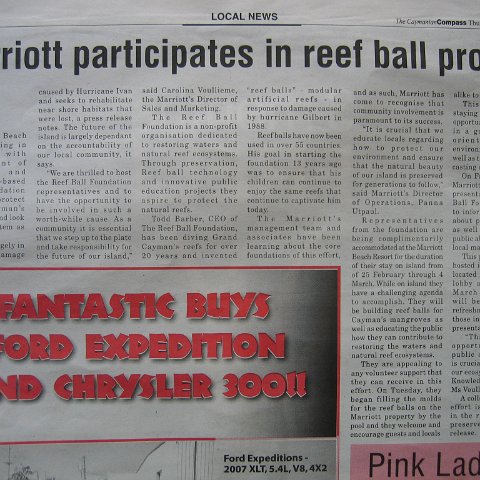
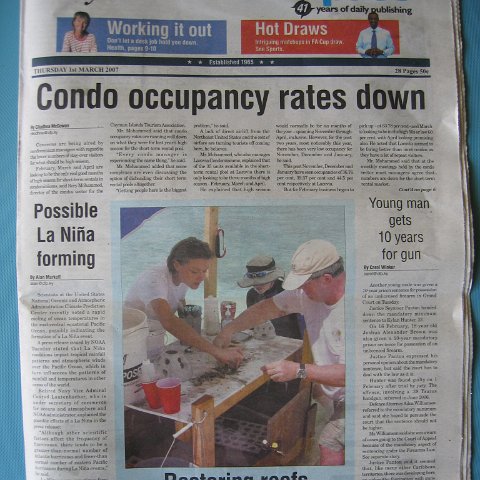
Reef ball project under way Wednesday 28th February, 2007 Posted: 17:03 CIT (22:03 GMT) > Comment on this story The Marriott Beach Resort is working in collaboration with the Department of Environment and the visiting US?based Reef Ball Foundation in an effort to protect and restore Cayman?s spectacular reefs. This effort is largely in response to the damage caused by Hurricane Ivan and seeks to rehabilitate near shore habitats that were lost, a press release notes. The future of the island is largely dependant on the accountability of our local community, it says. ?We are thrilled to host the Reef Ball Foundation representatives and to have the opportunity to be involved in such a worth? while cause. As a community it is essential that we step up to the plate and take responsibility for the future of our island,? said Carolina Voullieme, the Marriott?s Director of Sales and Marketing. The Reef Ball Foundation is a non?profit organisation dedicated to restoring waters and natural reef ecosystems. Through preservation, Reef ball technology and innovative public education projects they aspire to protect the natural reefs. Todd Barber, CEO of The Reef Ball Foundation, has been diving Grand Cayman ?s reefs for over 20 years and invented ?reef balls? ? modular artificial reefs ? in response to damage caused by hurricane Gilbert in 1988. Reef balls have now been used in over 55 countries. His goal in starting the foundation 13 years ago was to ensure that his children can continue to enjoy the same reefs that continue to captivate him today. The Marriott?s management team and associates have been learning about the core foundations of this effort, and as such, Marriott has come to recognise that community involvement is paramount to its success. ?It is crucial that we educate locals regarding how to protect our environment and ensure that the natural beauty of our island is preserved for generations to follow, ? said Marriott?s Director of Operations, Panna Utpaul. Representatives from the foundation are being complimentarily accommodated at the Marriott Beach Resort for the duration of their stay on island from of 25 February through 4 March. While on island they have a challenging agenda to accomplish. They will be building reef balls for Cayman?s mangroves as well as educating the public how they can contribute to restoring the waters and natural reef ecosystems. They are appealing to any volunteer support that they can receive in this effort. On Tuesday, they began filling the molds for the reef balls on the Marriott property by the pool and they welcome and encourage guests and locals alike to join in.....
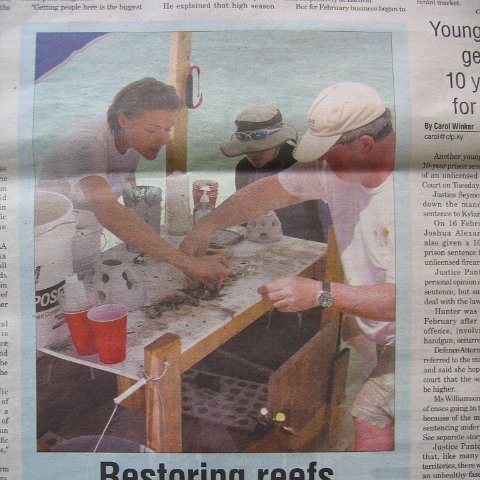
Dr. Lee Harris, Associate Professor of Ocean Engineering, and DMES graduate students, (pictured left to right in upper left photo below) Dana Arnouil, Aurélie Moulin, and Jenna Vogt, volunteered with the Reef Ball Foundation on Grand Cayman February 17-24, 2007. Dr. Harris works closely with the Reef Ball Foundation, a non-profit organization that developed Reef Balls. These artificial reef units can be used to promote shoreline stability and for reef restoration and mitigation of damaged coral reefs. Reef Balls are made of marine-friendly concrete, and can be anchored into the ocean floor to prevent movement. They can be used as submerged breakwaters and are habitats for rescued imperiled corals (corals that have been damaged by storms). In February 2007, the students participated in the construction of five new concrete reef balls and the propagation of coral onto already deployed units. The reef balls were deployed onto an existing reef restoration project in an area locally known as Cemetery Reef, located north of Seven Mile Beach. The coral propagation process then took place, where imperiled corals were gathered and rescued, and then brought back to a designated nursery, where they were carefully placed into concrete plugs. Divers were then sent out with the plugs to plant the 350 rescued coral fragments onto the reef balls, giving the corals a chance for re-growth, creating an artificial reef which will provide a natural marine habitat for benthic and pelagic sea life.