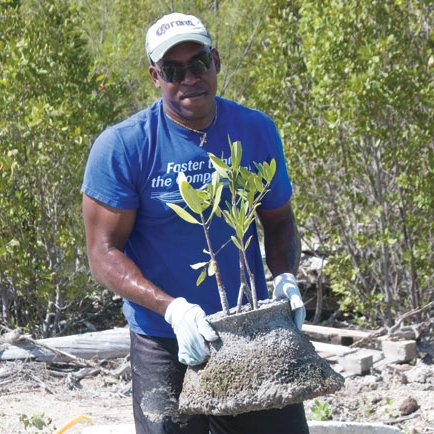
Governor supports mangrove project Thursday, January 25, 2007 The Department of Environment (DoE) has partnered with the Reef Ball Foundation in starting up the Mangrove Restoration Project in an effort to save one of the Cayman Islands? most critical plant. This project, which began in November 2005, is on a plot of land owned by and nearby the Red Bay Sailing Club. According to reports from the DoE, the declining mangrove situation was grossly exacerbated by Hurricane Ivan in 2005 and during the 2005 hurricane season. However, extensive damage of remaining mangrove areas has further opened up the potential for their development, though, conversely, the storm has also awakened an increased public awareness of the fragile nature, as well as the importance of the Island?s ecosystem. Therefore, environmental decisions and activities undertaken over the next few years may be of the utmost significance for the long-term ecological future of the Cayman Islands. DoE staff in charge of the project has been planting a number of mangroves and monitoring the site. H.E the Governor, Stuart Jack, and his wife, Mariko became part of the ?planting process?, on Friday 19 January, when they visited the mangrove site. According to Tim Austin, Assistant Director of Research and Assessment (DoE), the Governor was invited because they wanted him to be part of an important process. During his brief remarks, Governor Jack pointed out that it quite important that ?we look after our mangroves?. He was also pleased that ?a lot of young people are involved in the project.? Gina Ebanks-Petrie, Director of the Department of Environment, Matt Cottam, Terresterial Ecologist, and James Gibb, Research Officer were also present to lend a helping hand. The project involves the implementation of a high-survivorship headstarting protocol, using Reef Ball technology. This involves using reef balls to headstart and anchor the seedlings in place, re-establishing mangroves in denuded areas. While the initial outlay per seedling is high, once pioneer seedlings are established, they will provide shelter for further back-planting. This novel methodology additionally has the potential to showcase a restoration technique which may be implemented, by private landowners, and will be accompanied by an ongoing monitoring programme to evaluate comparative survivorship and costeffectiveness. Restoration activities will be supported by an extensive interactive website, interpreting projects in the context of local biodiversity and international environmental responsibility. The DoE reported that in the Cayman Islands, as in many areas of the world, traditional under-valuing of mangrove habitat as a natural resource has contributed to a precedent for rapid wetland reclamation and development. The mangroves play a very significant role in the Cayman?s ecosystem. They are a critical habitat for key local species including the Yucatan Vireo (Vireo magister caymanensis), the (nearthreatened) Cayman Parrot (Amazona leucocephala caymanensis), and the main breeding site for the (vulnerable) West Indian Whistling-.....
Cayman's Mangrove Population Recieves Boost 29/01/2007 Cayman's mangrove population has received a boost thanks to a new restoration project by the Department of Environment. The first phase of the project is now complete with the planting of more than 800 reef ball units containing thousands of mangrove seedlings. DoE Assistant Director Tim Austin said that with approximately 860 "reef balls" of seedlings planted in pots made out of marine-based cement, the young mangroves are protected against storms and have a better chance of surviving. It is hoped, Mr. Austin said, that this technique will be established to restore other areas that were damaged by Hurricane Ivan in 2004. These areas include, but are not limited to, North Side Public Beach near the Kaibo, and South Sound. The project, which started in November 2006, was assisted by many school and civic groups, who collected and planted thousands of seedlings. His Excellency the Governor, Mr Stuart Jack, accompanied by his wife, Mariko, planted the last seedlings on Friday, January 19. The project was sponsored by US Fish and Wildlife Service's Neo-tropical Migratory Bird Conservation Act for its practical contribution towards the restoration of migratory bird habitat. The DoE has worked with the Reef Ball Foundation (who manufactured the reef balls overseas) to build a red mangrove nursery at the Cayman Islands Sailing Club in Red Bay. The Sailing Club is a Darwin Initiative partner and donated the use of the site for the mangrove nursery. When the seedlings have reached a reasonable size, DoE Research Officer James Gibb said they will be transported to areas in need of mangrove restoration. This will head-start the restoration of the coastal mangroves, and encourage the re-establishment of mangrove habitats before the next hurricane season. The DoE is currently obtaining the moulds for the reef balls, so that, if the project is successful, they.....
Interest growing in mangrove restoration project Tuesday 6th February, 2007 Posted: 14:45 CIT (19:45 GMT) > Comment on this story The Department of Environment recently completed its first phase of a project to help restore locally devastated red mangroves by planting more than 800 reef ball units containing thousands of mangrove seedlings. Governor, Stuart Jack, accompanied by his wife, Mariko, planted the last seedlings on Friday, 19 January. The project was sponsored by US Fish and Wildlife Service?s Neo?tropical Migratory Bird Conservation Act for its practical contribution towards the restoration of migratory bird habitat, said a GIS press release. The DoE has worked with the Reef Ball Foundation (who manufactured the reef balls overseas) to build a red mangrove nursery at the CI Sailing Club in Red Bay. The Sailing Club is a Darwin Initiative partner and donated the use of the site for the mangrove nursery. ?With approximately 860 ?reef balls? of seedlings planted in pots made out of marine?based cement (Ph balanced for marine environments), the young mangroves are protected against storms and have a better chance of surviving,? said DoE Assistant Director Tim Austin. ?We are hoping to establish this as a technique to restore other areas that were damaged by Hurricane Ivan in 2004,? continued Mr. Austin. These areas include, but are not limited to, North Side Public Beach near the Kaibo and South Sound. The project, which started in November 2006, has drawn the interest of school children and community groups. Many people have assisted the DoE in collecting and planting thousands of seedlings, including students from Cayman Prep, St Ignatius and John Gray Recyclers. ?After the coming hurricane season, when the seedlings have reached a reasonable size, we are going to transport them to areas that need restoration,? explained DoE Research Officer James Gibb. ?This will head?start the restoration of our coastal mangroves, and encourage the re? establishment of habitats critical to the health our marine systems, and resident and migratory birds? populations. ?The DoE is currently obtaining the moulds for the reef balls, so that, if the project is successful, we will be in a position to build more reef balls on island, rather than having to import them from overseas. ? After planting the last two sets of seedlings, Mr. Jack commented, ?It is vitally important to look after the mangroves. This is a great project, and it?s pleasing to see young people getting involved ? this is a fun and......